



To commemorate the Centenary of the Pontifical Approval of the Teresian Association (TA), friends and members of this Catholic International group present in South Florida since 1961, gathered at the Poveda Center in Miami for the first of two talks, in Spanish, under the title: St Pedro Poveda and Teresa of Jesus: Wisdom for the laity today.
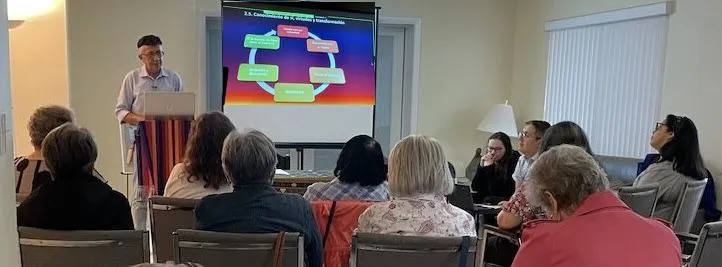
The speaker for both presentations is the carmelite priest Javier Sancho Fermín who for years was director of the International ‘Centro Teresiano Sanjuanista’ in Ávila, Spain, and is in Miami on sabbatical year.
The ideal
In the first part of his first talk, on june 15, Fr. Sancho centered on The Teresian humanism with which St. Pedro Poveda fell in love and he began by recalling that Poveda had proposed to his followers from the beginning of his work, “the ideal of a fully human life.” He recalled a key statement of Poveda inviting the members of the TA to live “the truest holiness, being at the same time human, with true humanism.”
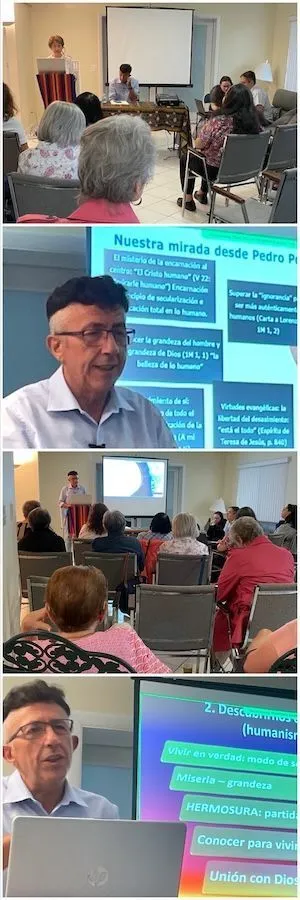 “The type of humanism that Teresa de Jesús and Pedro Poveda are proposing, the priest said, is not the humanism simply of human rights or the humanitarianism of helping those who are in need, or the humanism of social works.” It is “a much deeper humanism that touches the very roots of the understanding of the human being, and because of that, Poveda's intuition is incredibly current, essential and necessary: A true humanism.”
A genius
He explained that this humanism is about “knowing the greatness of the human being and knowing the greatness of God.” Two elements that are always in dialogue in Teresa and Poveda, a deeply theological humanism that looks at persons in God and from God. That expresses the need to be more authentically human through a path of prayer as a relationship, personal self-knowledge, learning to be free and through the centrality of love.
The speaker recognized that “Pedro Proveda is a genius, in the sense of having entered –at the beginning of the 20th century– into the heart of the Teresian doctrine into which many had not yet entered.
Indestructible root
During the second part the talk, with texts by Teresa de Jesús, especially her masterpiece: The Interior Castle, he pointed out that “the humanism that Teresa proposes to us goes far beyond any other humanism that we can imagine,” because it is a humanism that sinks its very roots in God's project for the individual, created in the image and likeness of God, thus ensuring “that our dignity cannot be touched by anything or anyone.”
Teresian humanism, he stressed, “leads us to understand that my dignity can never be hurt because it is an essential element of my own being, which will always be there, no matter what happens. Seeing ourselves in our dignity takes us out of the mud of the reality of life and gives us an indestructible root, beyond what I feel. And thus, the person is capable of being reborn from any circumstance.”
Living this conviction is what Teresa calls the first great grace, the speaker recalled. The greatest gift that God can give us: self-knowledge, “and only by discovering my dignity at the deep root of my being, am I able to open my eyes to the greatness and beauty of the humanity of others.”
He explained that “the humility that Teresa speaks about in her teaching is based precisely in her insistence on “waking in truth” the truth of one´s dignity.
For the priest “This is the background of Pedro Poveda's true humanism”. A humanism in which “we do not start from our condition as sinful beings who have to earn salvation, but rather we start from the condition of our beauty and greatness that enables us to realize and live the fullness of what we already are.” We are “like a castle made entirely of diamond or very clear crystal,” as Teresa expresses at the beginning of her book The Interior Castle.
Feet on the ground
For the speaker, what Teresa proposes is a great humanistic revolution. Because if we see ourselves favored, if we see ourselves rich, as Teresa says. If we see that our humanity is such a beautiful and great thing and not just a source of sin... then we will act accordingly.
The more saintly –Teresa of Avila would say– the more conversational, that is, the higher we get spiritually, the more human, and more with our feet on the ground. It is a humanism of life. And that is why the ‘houses’ of the Teresian Association, Pedro Poveda said, “must be schools where that kind of humanity is lived,” the priest noted.
“To assume our beauty and greatness, to live in accordance with our condition of being the image and likeness of God, there is our beauty,” indicated Father Sancho. “This is, in short, the true humanism into which Saint Teresa and Saint Pedro Poveda introduce us.”
A. Cantero, Miami.
 Published in News
Comments will not be posted automatically, they are subject to moderation.
The email address WILL NOT BE VISIBLE in the comments section.